
Description
A Business Process Modelling (BPM) language allows the definition of a graphical representation of a business process or workflow that includes attributes such as events that occur within a workflow, who owns and starts those activities, decision points and different paths workflows can take based on their outcomes, devices involved, a timeline of each step and success and failure rates of the process.
BPMN, the most popular business process modelling language6 provides a standardised graphical notation that is easy to use for business analysts, allowing them to document and communicate their business processes within their company and external business partners. Several open-source and commercial tools support BPM, such as Signavio, Camunda and Kissflow.
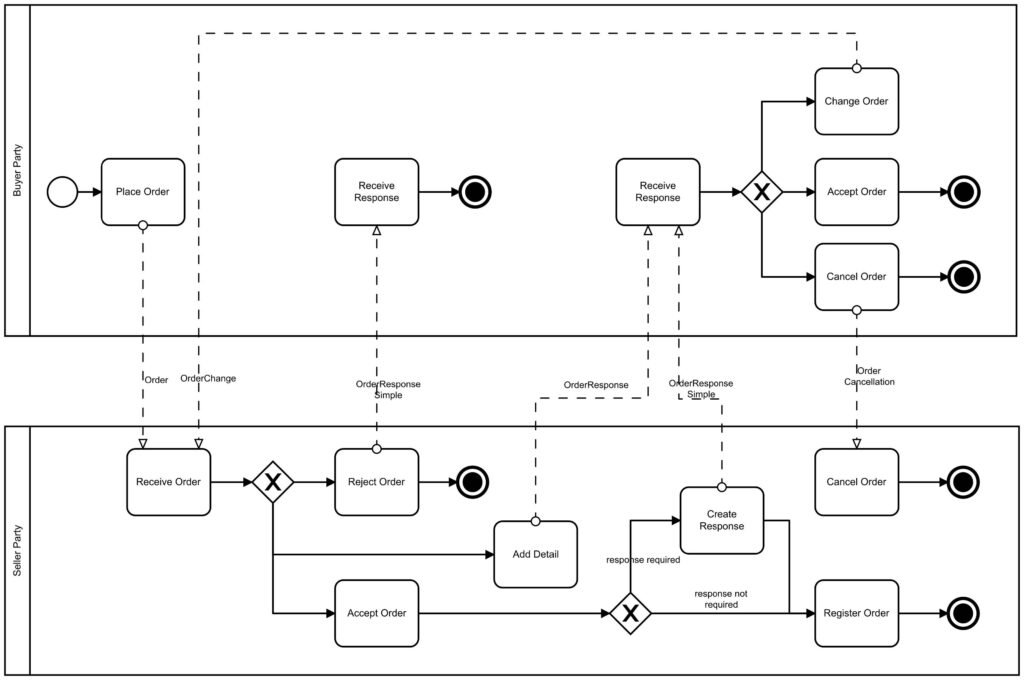
In the supply chain domain, BPMN is often used to represent interactions between supply-chain participants. For example, the following description is used by the UBL standard to denote how orders are processed:
Resources
This is the classic reference on business process modelling
Dumas, Marlon, Fundamentals of Business Process Management (Springer, 2013)
To find out more about process mining you can Join the Academic Alliance – Business Process Mining | Apromore
FAQ
What is the difference between business process modelling and business process mining?
Business process modelling creates the business process from a spec (top down) and process mining extracts the business model from existing data such as event logs (bottom up).